Insights
AI Is Reshaping Middle Management
AI is not removing the need for managers. It is removing the need for administrative coordination. The distinction matters.
Across service industries, organizations are reducing management layers while expanding the scope and accountability of the managers who remain. Job postings for middle management have fallen sharply since 2022. At the same time, managers with AI fluency and strong human leadership capabilities are earning significant wage premiums.
Five Structural Shifts Now Underway
- Coordination Is Automated. Reporting, tracking, summarizing, and status management are increasingly handled by AI systems.
- Span of Control Is Expanding. Managers now oversee more people with fewer layers.
- Career Ladders Are Compressing. Fewer stepping-stone roles mean fewer traditional promotion pathways.
- AI Fluency Commands a Premium. Roles requiring AI capability are being repriced upward rapidly.
- Human Leadership Is Scarce. Coaching, influence, negotiation, and change leadership are becoming more valuable, not less.
The Four Questions Every Manager Should Ask
- How exposed are my daily tasks to automation?
- Do my natural work-style strengths align with automation-resistant leadership traits?
- Is my compensation aligned with AI-augmented management benchmarks?
- Is hiring demand for my role accelerating or cooling?
Guesswork is risky. Measurement creates leverage.
If You Are an Active Job Seeker
- Reframe your experience around human-centered outcomes.
- Demonstrate operational AI fluency.
- Target sectors with positive hiring momentum.
- Prepare for judgment-based interviews.
- Negotiate using real-time salary alignment data.
If You Are Employed But Seeking Opportunities
- Audit your exposure.
- Position yourself in AI-driven value creation.
- Build external optionality before compression occurs.
- Time career moves from strength, not urgency.
The Reality
- AI will reshape management roles unevenly across sectors.
- Managers who combine measurable leadership defensibility with practical AI fluency will see expanding opportunity and compensation growth.
- Those anchored primarily in coordination tasks will see narrowing pathways.
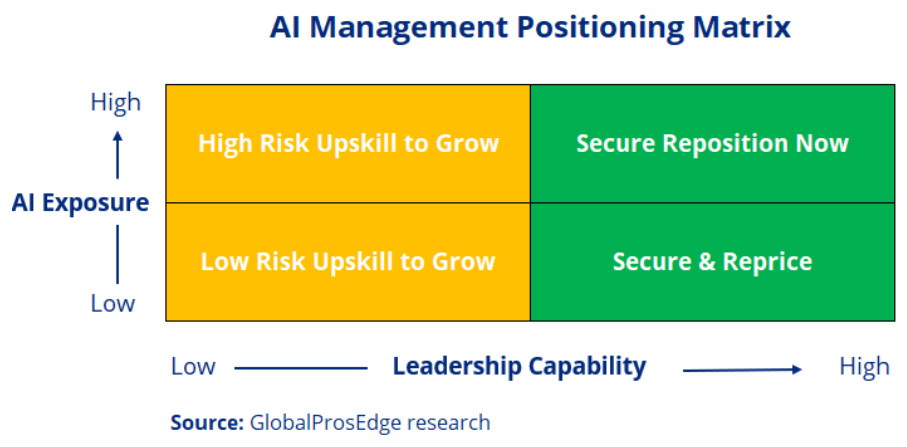
The window to reposition is open now. Where does your role fall?
Applying These Insights to Your Own Role
The research in this paper highlights a central reality. Career positioning in an AI-driven workplace should be based on measurement, not guesswork.
Professionals who want to understand how their own role may evolve can evaluate four measurable factors:
- Work-style leadership strengths (TraitDNA™ work-style measurement).
- Task-level AI exposure within their occupation.
- Real-time compensation alignment in the labor market.
- Hiring demand for their role.
You can access the TraitDNA™ work-style measurement and related career indicators at GlobalProsEdge.ai.
AI and Middle Management Today
The Data
Middle management has been a corporate fixture since the 1920s, existing to translate executive strategy into frontline execution, filter information flowing in both directions, and absorb the coordination friction of large organizations. For a century, that role justified itself. What AI has exposed is that a significant portion of it was always administrative overhead, not irreplaceable human judgment.
According to Deloitte's Future of Work and AI Report (2025), middle management job postings dropped more than 40% between April 2022 and October 2024 as companies began building flatter structures. Tasks once tracked by managers, taking meeting notes, drafting status updates, aggregating performance data, are now frequently handled by AI tools without any human manager involved. This is not a sudden disruption. It is the acceleration of a slow erosion, now made visible by generative AI and consequential by corporate restructuring.
The statistics on AI and middle management are consistent across sources. Gartner's October 2024 Top Strategic Predictions report forecast that through 2026, 20% of organizations will use AI to eliminate more than half of current middle management positions. A Korn Ferry survey found 44% of U.S. professionals say their company has already cut back on manager-level roles. According to Challenger, Gray & Christmas outplacement data, summarized by CNBC and Fortune (October 2025), roughly 55,000 U.S. jobs in 2025 were cut with AI explicitly cited, concentrated in coordination-heavy and middle-management roles.
Management Redefinition
Unbossing. Major corporations are actively eliminating management layers to reduce expense and accelerate decision-making. In 2024, pharmaceutical giant Bayer announced it would ask nearly 100,000 employees to self-organize as part of a restructuring expected to save $2.15 billion, according to Fortune (April 2024). Deloitte's Future of Management analysis (December 2025) identified this as part of a widespread structural shift toward flatter organizations designed to place decision-making closer to customers. The economic logic is straightforward: each layer of management adds salary cost, slows communication, and creates distance between leadership and operational reality. As AI systems increasingly handle coordination, reporting, and routine oversight, companies now see management reduction as one of the fastest ways to improve efficiency.
New operational risks. While flatter structures reduce cost and accelerate execution, Deloitte cautioned that indiscriminate delayering can undermine organizational stability. Managers do more than assign tasks, they preserve institutional memory, mentor employees, and resolve complex problems that fall outside formal processes. Eliminating too many managers weakens these informal support networks, which no AI system can fully replace. This strain is already visible. Gallup's 2025 engagement research found that managers experienced the sharpest decline in engagement of any employee group, reflecting heavier workloads and reduced organizational support. In other words, unbossing shifts responsibility downward and concentrates pressure on the remaining managers rather than eliminating the need for management itself.
All businesses affected. The change is not limited to global corporations. According to PYMNTS.com (July 2025), citing payroll platform Gusto, the average number of direct reports per supervisor in small and medium-sized businesses doubled from three in 2019 to six in 2024. AI tools now perform many functions that previously required supervisory oversight, including preparing presentations, tracking project progress, and collecting performance feedback. As a result, each manager can oversee significantly more employees. This expansion of managerial span-of-control demonstrates that AI is fundamentally changing organizational economics at every company size, not just the Fortune 500.
Role redefined. Organizations are not eliminating management because leadership is no longer necessary, but because technology allows fewer managers to oversee more people. This structural shift increases efficiency but also raises the importance of the managers who remain. They must handle broader teams, more complex coordination, and higher-stakes decisions. The result is a workforce where traditional middle-management roles decline in number, but managerial capability becomes more valuable and more demanding than before.
Career Ladder Problem
Pipeline Compression. One of the least recognized consequences of AI-driven delayering is the compression of the traditional career ladder. Middle management has long served as both a destination and a developmental stage, where employees transitioned from executing tasks to leading people. As individual contributors were promoted, they learned judgment, coordination, and strategic thinking through real responsibility. With fewer management roles now available, this progression is narrowing, reducing the number of opportunities where employees can develop the leadership capabilities organizations ultimately depend on.
Learning Loss. Many of the tasks AI now performs were not merely administrative overhead, they were the training ground for future leaders. Deloitte's Future of Work and AI Report (2025) warned that while AI improves efficiency by handling tasks such as meeting notes, summarization, and action tracking, it simultaneously removes critical opportunities for junior employees to learn how organizations function. These activities taught employees how to synthesize information, anticipate problems, and manage competing priorities. Without this experiential learning, employees may advance technically but lack the operational judgment required for leadership.
Promotion Disruption. AI augmentation is fundamentally altering promotion pathways by allowing fewer employees to perform higher-level coordination work. A Pega survey analysis found that AI tools now enable junior analysts to perform tasks that previously required experienced managers, making traditional promotion benchmarks less relevant. At the same time, companies are hiring fewer entry-level workers, reducing the size of the future leadership pool. In 2024, large technology firms reduced new graduate hiring by approximately 25 percent, signaling a structural contraction at the very point where leadership pipelines historically began. This dual effect, fewer entry roles and fewer management positions, creates a bottleneck that limits the development of future leaders.
Leadership Shortage. The long-term risk is not theoretical, it is structural. Organizations that reduce management layers today may lack experienced leaders tomorrow. Deloitte's research emphasizes that the most critical management capabilities, coaching employees, navigating change, and maintaining motivation during uncertainty, are developed through years of practical experience, not through AI tools or certifications. Leadership cannot be generated on demand. Companies that weaken their internal development pipelines risk facing a leadership deficit precisely when strong human leadership is most essential to guide teams through ongoing technological transformation.
Guidance for Current Managers
Management Role Structural Shift
Administrative displacement. The administrative tasks that defined management for decades, organizing information, tracking progress, distributing work, and producing reports, are now performed faster and more cheaply by AI. The value of management is shifting away from coordination efficiency and toward capabilities AI cannot replicate, including:
- Judgment.
- Prioritization.
- Leadership.
Value shift confirmed. Independent research confirms this structural transition. Gartner reported in its October 2025 CIO survey that by 2030, 75 percent of IT work will be performed by humans augmented by AI and 25 percent by AI alone, with virtually no work performed without AI involvement. McKinsey & Company similarly found in its 2025 skills analysis that while over 70 percent of core skills remain relevant, their economic value increasingly depends on interpretation, decision making, and human judgment rather than routine execution.
Exposure visibility. This shift is measurable at the task level. The GlobalProsEdge AI Work Exposure Index identifies which management tasks are vulnerable to automation, and the extent of their vulnerability, and which depend on human leadership. Managers with higher exposure to automation must reposition toward:
- Coaching.
- Decision making.
- Strategic leadership.
while those already focused on human-driven responsibilities are better aligned with future demand.
AI Fluency Is Rapidly Increasing Management Value
Wage repricing. The labor market is already rewarding managers who demonstrate AI fluency. PwC's 2025 Global AI Jobs Barometer found that roles requiring AI skills command a 56 percent wage premium, more than doubling from 25 percent the prior year. This reflects a rapid repricing of management talent toward those who can integrate AI into workflows and decision making.
Leverage visibility. As compensation adjusts quickly, managers benefit from knowing their precise market position. The GlobalProsEdge Compensation Alignment leverage indicator uses real-time salary data from 95 percent of live U.S. job postings to show whether a manager's current compensation is below, aligned with, or above market. This, along with other data, provides objective insight into negotiating leverage, helps managers time job changes strategically, and enables more confident salary negotiations based on current market demand rather than outdated benchmarks.
Practical capability. AI fluency for managers is primarily operational. It involves identifying:
- Team tasks that can be automated.
- Critically evaluating AI-generated outputs.
- Guiding teams through adoption.
The World Economic Forum's Future of Jobs Report 2025 identified AI and data literacy as the fastest growing competency category globally.
Market signaling. Managers who actively use AI tools and pursue AI-related certifications signal readiness for modern leadership. Research cited in Aristek Systems' 2025 adoption analysis found that 33 percent of managers already use AI tools frequently, compared to only 16 percent of individual contributors. This visible engagement increasingly influences hiring, promotion, and compensation decisions.
Human Leadership the Advantage
Automation limits. While AI can automate technical and administrative work, it cannot replace relationship-driven leadership. The Society for Human Resource Management's 2025 automation risk study found that only 6 percent of jobs are highly automatable without significant human barriers such as trust, context, and leadership responsibility. These human factors protect management roles, but only for managers who actively demonstrate leadership capability.
Coaching priority. Coaching and people development have become central management responsibilities. Deloitte's 2025 Global Human Capital Trends report found fewer than four in ten managers feel prepared to lead the human side of transformation. Managers who can:
- Develop talent.
- Align teams.
- Maintain engagement.
fill a critical leadership gap.
Influence expansion. Management roles are evolving from supervision toward influence and alignment. Harvard Business School research analyzing 34 million postings found increasing emphasis on:
- Collaboration.
- Persuasion.
- Cross-functional coordination.
Managers who can build alignment and guide decisions across teams provide value that automation cannot replace.
Change Leadership the Bottleneck
Leadership constraint. The primary barrier to successful AI adoption is leadership, not technology. Deloitte's 2025 research found organizations achieve stronger results when managers actively guide:
- Workflow redesign.
- Behavioral change.
- Trust building.
The effectiveness of AI implementation depends heavily on management capability.
Transformation readiness. Managers who participate in AI adoption initiatives and organizational transformation strengthen their long-term market value. Demonstrating:
- Adaptability.
- Initiative.
- Strategic thinking.
positions managers as leaders of change rather than passive observers of automation.
Future definition. Gartner emphasized at its 2025 IT Symposium that AI will redefine management rather than eliminate it. Managers who combine technological fluency with human leadership capabilities will become more valuable, while those focused primarily on administrative coordination will face declining demand.
Measured Strengths Increase Career Leverage
Capability measurement. Objective measurement of leadership strengths provides clarity and credibility. Vendors with work-style measurement applications such as GlobalProsEdge's TraitDNA™ identify behavioral capabilities linked to modern management effectiveness, including critical thinking, adaptability, and leadership orientation. These strengths increasingly determine long-term career trajectory.
Signal visibility. Managers must make future-relevant capabilities including work-style strengths visible. Updating professional profiles, documenting leadership outcomes, and demonstrating AI engagement signal readiness to employers. PwC's 2025 research confirms that visible AI engagement has become an important evaluation factor in hiring and promotion decisions.
Career positioning. Managers who understand both their leadership strengths through applications such as TraitDNA™ and automation exposure through tools like the GlobalProsEdge AI Work Exposure Index can reposition toward high-value responsibilities. This strengthens compensation negotiating leverage, improves career resilience, and increases access to leadership opportunities. As management roles evolve, those who demonstrate measurable human leadership capability alongside AI fluency will experience the greatest compensation growth and long-term security.
Guidance for Job Seekers in Management
Reframe Your Resume Around Human-Centered Outcomes
Higher bar. If you are pursuing a management role in an AI reshaped market, the opportunity is real, but so is the standard. Organizations are no longer hiring administrators to manage reports and schedules; they are hiring leaders who can exercise judgment, develop people, and guide change. Your resume must reflect this shift clearly and deliberately.
Outcome focus. The administrative tasks that once defined management roles are now assumed to be automated. Employers scanning resumes are looking for measurable human-centered outcomes:
- Teams you built.
- Conflicts you resolved.
- Cultures you strengthened.
- Transformations you led.
Deloitte in its 2025 Global Human Capital Trends report identified:
- Coaching.
- Change facilitation.
- Motivating through uncertainty.
Quantified results such as reduced turnover, improved engagement, or successful restructuring signal value that cannot be automated.
Measured strengths. GlobalProsEdge TraitDNA™ work-style measurements objectively identify whether your natural strengths align with critical thinking, people leadership, adaptability, and influence. Instead of vaguely claiming leadership ability, you can demonstrate measured suitability for the human-centered capabilities employers now prioritize.
When paired with the GlobalProsEdge AI Work Exposure Index, you can show not only where automation risk exists in your role, but how you have deliberately concentrated your work on responsibilities AI cannot replace, strengthening your long-term value.
Build AI Fluency
Market premium. AI capability is no longer optional for managers. PwC reported in its 2025 Global AI Jobs Barometer that roles requiring AI skills command a 56 percent wage premium. This reflects a rapid repricing of management talent toward leaders who can integrate AI into workflows rather than resist it.
Practical readiness. Completing recognized AI certifications through providers such as Google, Microsoft, Coursera, or LinkedIn Learning demonstrates:
- Decision readiness.
- Ability to evaluate AI outputs.
- Determine when human review is required.
- Guide teams through adoption.
Managers who combine AI literacy with TraitDNA™ behavioral indicators of analytical thinking and adaptability position themselves as accelerators of transformation rather than obstacles.
Compensation leverage. GlobalProsEdge Compensation Alignment indicators based on real-time salary data add another layer of negotiating strength. If your measured AI fluency and leadership capabilities align with higher-paying market benchmarks, you gain objective support for salary discussions based on current market data.
Target Growth Sectors Strategically
Selective expansion. Not all industries are reducing management layers. The World Economic Forum projects a net gain of 78 million jobs globally by 2030, particularly in AI development, cybersecurity, sustainability, and healthcare.
Data-driven targeting. Evaluate company posting trends, management-to-individual-contributor ratios, and growth signals before applying broadly. GlobalProsEdge Hiring Demand reports and the AI Work Exposure Index help identify industries moving toward strategic leadership rather than task-oriented management.
Alignment strategy. Combining industry growth data with your TraitDNA™ profile helps you pursue roles aligned with both market expansion and your natural strengths, improving long-term stability and compensation growth.
Position Yourself as a Human-AI Collaboration Leader
Transformation gap. The most differentiated managers are those who have led teams through AI adoption, not simply used AI personally.
Documented experience. If you have:
- Redesigned workflows.
- Integrated automation.
- Coached teams through technological change.
Present these experiences explicitly in resumes and interviews.
Increase Visibility in AI Adjacent Communities
Strategic visibility. Participate in AI-focused professional communities to increase exposure to future-ready leadership opportunities.
Reputation building. Publishing insights, contributing to discussions, and speaking at events signals expertise and engagement.
Prepare for Judgment Based Interviews
Beyond familiarity. Progressive employers increasingly test AI judgment rather than simple tool usage.
- Decision making.
- Ethical considerations.
- Coaching ability.
Human advantage. Prepare examples demonstrating:
- Empathy.
- Reasoning.
- Change facilitation.
Negotiation strength. When you understand your TraitDNA™ strengths, AI Work Exposure Index level, and Compensation Alignment indicators, you enter interviews and salary discussions with evidence rather than opinion.
Guidance for Employed Managers Seeking New Opportunities
Strategic Leverage in an AI-Shifting Organization
For managers who are currently employed but watching AI reshape their environment, the strategic calculus is fundamentally different from that of active job seekers. You have leverage: a current title, internal credibility, live organizational data, and firsthand visibility into how automation is altering workflows and headcount.
The challenge is not survival. It is positioning. The goal is to use that leverage deliberately, before your role is redefined, compressed, or quietly absorbed by automation.
GlobalProsEdge reframes this from guesswork to measurement. Rather than relying on intuition about risk, compensation, or opportunity, you can evaluate your position through four lenses: work-style defensibility, automation exposure, compensation alignment, and live hiring demand.
Here is how to apply that framework.
Conduct a Measured Audit of Your Role
The first step is not reflection, it is measurement.
Start by separating your responsibilities into two categories:
- AI-automatable coordination and analysis tasks.
- Human-dependent leadership activities.
Research such as MIT's State of AI in Business 2025 shows that professionals increasingly assign drafting, summarizing, and basic analysis to AI systems. If a meaningful share of your day is spent in those areas, your role may be more exposed than your title suggests.
The GlobalProsEdge AI Work Exposure Index quantifies this exposure using O*NET task mapping and its monthly updated proprietary occupation task data set for trend and projection analysis. Instead of estimating vulnerability, you see a scored task exposure level tied directly to your occupation.
Then assess the second dimension: defensibility. GlobalProsEdge TraitDNA™ work-style measurement identifies whether your strengths align with the most automation-resistant leadership traits, such as:
- Complex problem solving.
- Cross-functional influence.
- Talent development.
- Negotiation under ambiguity.
- Strategic decision framing.
If your TraitDNA™ profile skews strongly toward these areas, you are positioned for higher-value, AI-augmented management roles. If it does not, that is not a verdict, it is an adjustment signal.
The ratio between AI exposure and leadership defensibility should shape every decision that follows.
Align Yourself With AI Value Creation, Not AI Efficiency
Managers who become associated with AI-driven value creation are far more secure than those associated with operational oversight alone. McKinsey's State of AI 2025 finds that companies generating the strongest AI returns embed leaders into workflow redesign, not just tool deployment. The strategic move is to become the bridge between technology and execution.
Before volunteering blindly, measure the upside. GlobalProsEdge Compensation Alignment reports, based on real-time national salary data across 926 occupations, show whether managers leading AI initiatives are being paid at, above, or below market. If your compensation is misaligned relative to AI-enabled leadership roles, that gap represents either an internal negotiation opportunity or an external move signal.
At the same time, review real-time Hiring Indicators. If demand momentum for AI-augmented management roles is accelerating nationally, your leverage window may be open. If it is cooling, internal positioning may be the higher-return move.
This shifts the question from "Should I raise my hand?" to "Is the value I am creating being recognized and priced correctly?"
Build External Optionality While Employed
One of the most common strategic errors employed managers make is waiting for organizational contraction before activating their network.
GlobalProsEdge provides access to 95% of U.S. job postings in real time, allowing you to benchmark:
- Which companies are investing in AI-augmented management roles?
- Which industries show positive hiring demand momentum?
- Which regions are increasing compensation for AI-fluent leaders?
This is not about applying immediately. It is about maintaining market awareness.
Simultaneously, your TraitDNA™ results allow you to articulate leadership strengths in measurable language. Recruiters increasingly value evidence-based positioning over generic claims of "strategic leadership." A manager who can reference measured work-style alignment, AI exposure defensibility, and compensation benchmarking speaks from data, not assertion. Optionality built while employed preserves negotiation leverage later.
Is Your Organization Expanding or Contracting Management Scope
Not all AI adoption stories are the same. Some organizations treat AI as a force multiplier, redeploying managers toward strategic design, client advisory, regulatory navigation, and talent development. Others treat AI primarily as a cost-reduction mechanism, compressing managerial layers without rebuilding scope.
GlobalProsEdge Hiring Indicators allow you to compare your company's direction to national demand patterns. If your organization is reducing midlevel management while the broader market is increasing AI-enabled leadership hiring, that divergence is informative.
Your AI Work Exposure score combined with your company's behavior answers a critical question: Are you inside a growth narrative or a contraction narrative? The answer determines whether to double down internally or build toward transition.
Time Your Move From a Position of Strength
Managers who move while employed consistently command stronger compensation packages than those entering the market reactively.
With access to real-time compensation benchmarks and live demand momentum data, you can assess:
- Whether your current salary reflects AI-enabled leadership value.
- Whether national demand is peaking or plateauing.
- Whether adjacent industries offer stronger growth trajectories.
Because GlobalProsEdge surfaces opportunities across 95% of the U.S. job market in real time, you do not need to speculate about demand. You can observe it directly. The objective is not urgency. It is control.
A manager who understands their automation exposure, leadership defensibility, compensation alignment, and hiring demand trajectory is no longer reacting to AI disruption. They are strategically positioning within it.
The Core Principle
AI fluency alone does not create career security. Measured positioning does.
For employed managers, the advantage is time and leverage. The discipline is using objective data, TraitDNA™ defensibility, AI exposure scoring, compensation alignment, and real-time hiring signals to decide whether to:
- Expand internally.
- Renegotiate value.
- Transition strategically.
- Or deliberately hold position.
The environment is shifting. The question is not whether AI will reshape management. It is whether you will shape your role before it is reshaped for you.
Looking Ahead
Five-Year Horizon
Nonlinear, nonuniform impact. The trajectory of AI's impact on middle management will not be linear, and it will not be uniform across industries or company sizes. But several well-sourced projections provide a grounded picture of what is coming, and what leaders, whether organizational or individual, should be doing about it now.
Occupations will shift. The World Economic Forum's Future of Jobs Report 2025, based on surveys of over 1,000 employers representing 14 million workers across 55 economies, projected that 92 million jobs will be displaced by 2030 while 170 million new ones will be created, a net gain of 78 million. AI and information processing are expected to affect 86% of businesses by 2030. The net creation figure is encouraging, but it obscures a distribution challenge. The new roles are concentrated in AI development, cybersecurity, sustainability, and technically skilled fields, not necessarily in the management layers being eliminated today.
Agentic AI is accelerating. Deloitte's TMT Predictions 2025 forecasts that by 2027, half of companies using generative AI will have launched agentic AI applications capable of performing complex work with limited human oversight. These systems, capable of autonomously executing multi-step workflows, represent a qualitative shift beyond today's AI tools. Where current AI assists managers with tasks, agentic AI will begin replacing entire coordination workflows that currently require managerial judgment. The window for repositioning is open now. It will narrow as agentic systems mature.
AI Investment Is Growing Faster Than Organizational Adaptation
Gartner's longer-range forecast projects that while AI's impact on jobs will be broadly neutral through 2026, by 2036 it could create more than 500 million net new roles supporting AI-driven initiatives. McKinsey's 2025 survey found that 92% of firms plan to increase their AI budgets within the next three years, while 32% expect AI to reduce their workforce by at least 3% within the next year. The investment is accelerating faster than organizational and individual adaptation.
The Leadership Imperative in the Age of AI
Hype of AI replacing people is running ahead of operational reality. SHRM's CEO Academy analysis from December 2025 posed the question every leader should be asking: Can AI do this work reliably, legally, and culturally in our context? Until the answer is yes, layoffs tied to AI transformation are speculative at best. Even in high-tech fields like software engineering and finance, AI supplements human judgment far more than it replaces it.
Elevating humans, automating tasks. The organizations that will navigate AI most successfully are those that automate administrative coordination while preserving and strengthening the relational, strategic, and adaptive dimensions of management that remain deeply human.
Rather than simply removing middle managers, they will invest in AI fluency, redesign career paths beyond traditional layers, and expect the managers who remain to be more capable, not just fewer.
As Harvard Business Review noted in July 2025, deciding what to automate and what to preserve is not a technology decision but a leadership one, and for individual managers the parallel question is clear: are you building the capabilities and visibility that make you indispensable in an AI-shaped organization?
Measure Your Position in the AI-Shaped Workforce
The research presented in this report shows that career outcomes are increasingly shaped by four measurable factors:
- Work-style leadership strengths.
- Exposure of daily tasks to automation.
- Alignment between compensation and market demand.
- Hiring demand for your role.
GlobalProsEdge determines these measurements through:
- TraitDNA™ work-style behavioral traits.
- The AI Work Exposure Index™.
- Real-time compensation alignment indicators.
- Live hiring demand signals across 95% of the U.S. labor market.
These capabilities allow you to evaluate your position using data rather than assumption.
Readers interested in applying the framework described in this paper to their own career can access this measurement potential at GlobalProsEdge.ai.
About GlobalProsEdge
Research & Scientific Foundation
GlobalProsEdge.ai is built on a rigorous scientific foundation developed and continuously validated by GlobalProsLabs.ai, the research arm of the GlobalPros ecosystem. Led by PhD-level I/O psychometric psychologists, GlobalProsLabs designed and validated the TraitDNA™ work-style behavioral measurement, mapping its behavioral traits to the U.S. Department of Labor's O*NET work-style framework to ensure job-specific relevance and predictive accuracy.
While GlobalProsLabs establishes the scientific integrity, GlobalProsEdge operationalizes this research by combining TraitDNA™ results with real-time labor-market measurements, turning validated behavioral science into practical, personalized market signals for job seekers.
Continuous Validation & Real-Time Benchmarking
TraitDNA™ results are continuously benchmarked against O*NET standards and refreshed labor-market data to remain accurate, current, and job-relevant. GlobalProsEdge extends this foundation by integrating:
- Real-time job postings representing ~95% of U.S. openings
- Live compensation data by job, location, and experience level
- Task-level analysis of how AI is reshaping roles
- Six additional market signals reports derived from ongoing, real-time measurements
This approach ensures insights are not static snapshots, but living signals that reflect how hiring criteria, pay, and role expectations are changing right now.
Our Mission
Our mission is simple, help you understand how you work, and translate that understanding into better career outcomes. Too often, capable professionals are overlooked not because they lack skills, but because employers can't clearly see how they will perform, collaborate, and succeed in a role. GlobalProsEdge is designed to close that gap.
Turning Insight into Advantage
By grounding career guidance in scientifically validated measurements, real-time job data, and task-level analysis of AI's impact on work, GlobalProsEdge helps you gain clarity, confidence, and a measurable advantage in today's hiring market. Whether you are exploring options, actively applying, or planning your next move, your work style becomes something you can measure, explain, and use strategically.
Thank you for investing time in understanding your future.
Sources
- Gartner Top Strategic Predictions 2025 and Beyond
- Pega Global Executive Survey
- Deloitte 2025 Global Human Capital Trends and Future of Management
- Challenger, Gray & Christmas 2025 Layoff Reports
- SHRM 2025 Data Brief on Automation and Job Displacement Risk
- McKinsey State of AI 2025
- Harvard Business Review July 2025
- WEF Future of Jobs Report 2025
- PwC 2025 Global AI Jobs Barometer
- Korn Ferry Report on Manager Cutbacks
- Gallup 2025 Employee Engagement Survey
- MIT State of AI in Business 2025
- Gusto/PYMNTS Small Business Manager Data 2025
- Programs.com AI-Driven Layoffs Tracker
- National CIO Review December 2025
- Aristek Systems AI Statistics in 2025 and Beyond